Capilla del Pocito
💀💀💀💀
3.9/5
112 votes
About Capilla del Pocito
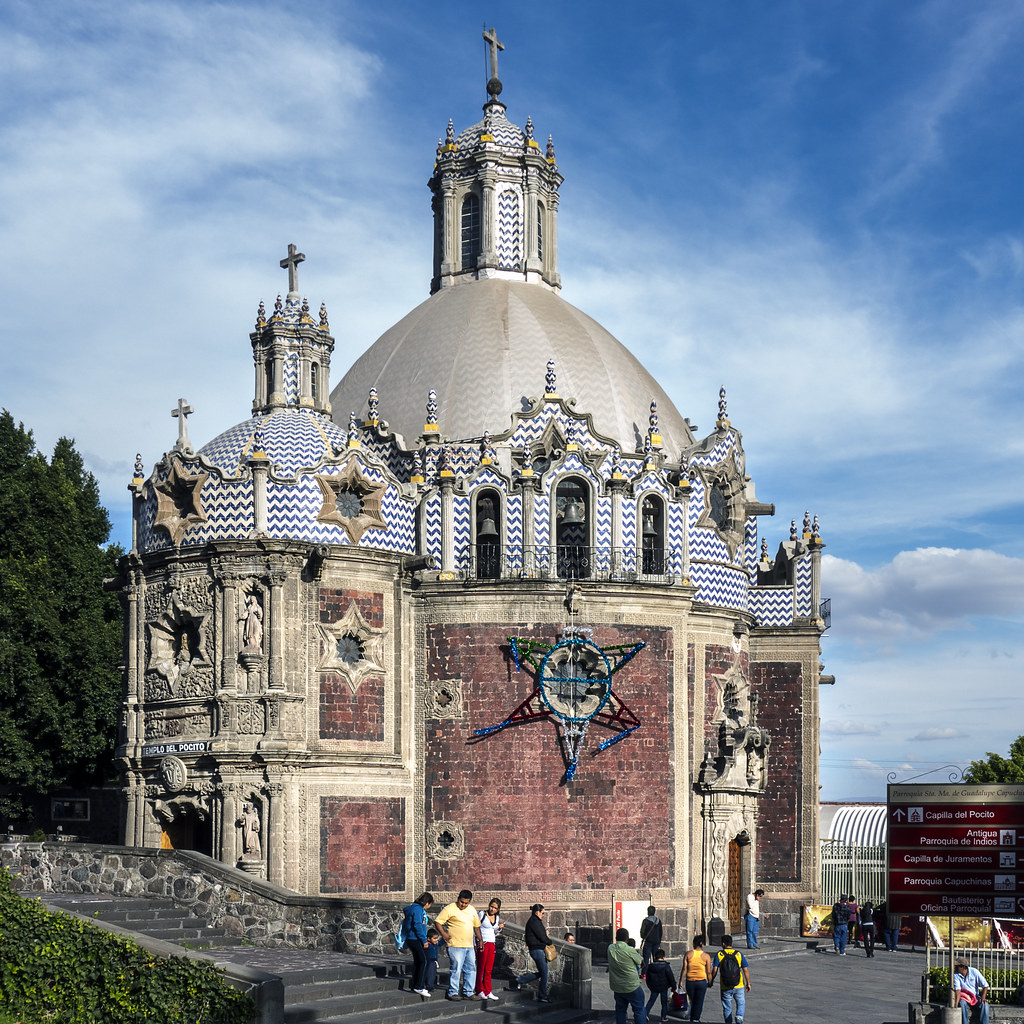
The Pocito Chapel, built from 1777 to 1797 in the village of Guadalupe, near Mexican City, is, with no doubt, the most original work of the colonial architecture of the continent. It was built to shelter a well whose water had miracle virtues. It is formed by a central oval space that comes after a circular vestibule where the well is located, and an octagonal sacristy whose sides are alternately straight and curved. This coupling of curved forms creates a strange plan that, in the beginning, one could think of Borromini or Guarini, but, it has a faraway reference. Guerrero Torres used as a model an old ruined Roman monument that was published by Serlio in his well-known treatise. What is interesting is that, although he faithfully respected that plan, the elevation is entirely different, creating one of the most original buildings that we know nowadays. He covered the three spaces with domes of different sizes and covered them with blue and white tiles from Puebla, whose patterns create a bent geometry. These domes are supported by tambours that are actively shaped and have the same tiling finish. The walls are built with an intense red volcanic rock – tezontle – and the façade and windows are made of white stone – Chiluca. The arches of the bays are shapely built, and the portholes have a star geometry. Everything has abundant ornamentation. To sum up, the violet curved plan, the three large volumes of the domes that partially overlap each other and the shinny polychrome of the tiles and stone, make the Pocito Chapel a very original monument where the fantastic imagination of the Mexican spirit achieved its zenith. The sensitivity of Mexican towards color and the endless creativity of Guerrero Torres made of this monument the most representative example of American Baroque.
Rate This Cursed Place
How cursed is Capilla del Pocito? Drag to vote 1-5 skulls.
Photos of Capilla del Pocito



Comments (0)
Add your comment